I tried to warn you guys that some topics will put me right over the top... there is a point (and I am close to that) that I will expand the entire thread until even I get naseous reading it. I only plan on upgrading this radio once, so I dug deeper...most of this is for me so I have it in one place and can look it up again in the future if I ever need to... you can skip the rest.. order has been placed $225 (including 2 day shipping, should be here 8/2/2012)
(2) sets of 6.5" db651
(1) 10" subwoofer
It seems that a lot of people like the Polk Audio for the cost/performance break point.
I found another search online that I found useful.
Hull Truth -- "reasonably priced marine stereo speakers?"MrBoo wrote:I'm an electrical engineer by trade and DJ by hobby so I've got a lot of experience with commercial audio. The same concepts should apply to every audio platform. As a general rule, I use amps that are rated 1.5-2 times the speaker for a given load. That means if the speaker is rated at 500 watts at 8 ohms, I'll use an amp that is rated at 750-1000 watts at 8 ohms. Now, that 500 watts would be the continuous rating. There are three. Continuous, RMS and peak. Of the three continuous is the one to pay attention to the most. If you can't get a continuous, the RMS would be next. Peak is pretty much useless in my book.
The reason you want to have the higher amp power than the speaker is head room. If you watch the meters while music is playing, the are constantly going up and down. Speakers rated at a wattage of continuous can sometimes take almost double for a short burst. The added head room allows you to take advantage of this. This also means your amp doesn't have to work as hard and you can play it at a lower volume level. The cause of most speaker failures is usually heat. Heat that is generated from running an amp to the point of distortion and that distortion is equal to pushing DC through them. DC is deadly to speakers. I also try to run the lightest load I can, meaning 8 ohms instead of 4 ohms or 2 ohms. The heavier load causes more current draw, which causes more heat loss in the wires and allows for power loss and line distortion to the speakers.
Subs are your best friend. Subs used with cross overs, that is. Cross overs allow you to make better use of the power use send to the uppers by limiting the frequencies sent to them. Most upper speakers drop off well before the lowest frequencies that are produced by the music. The means power is being wasted on music your speakers can't produce. Crossovers/subs make sure the frequencies sent to the uppers are well within their rating. The added plus is getting that thump from frequencies you can't hear but you can feel.
So to recap:
Look at the amp rating within the load range. (8 ohms is preferred) Yes, you have to pay more, but it's worth it in quality of sound and wear on your equipment.
Double your amp power rating to your speaker's continuous rating.
Look at all of the speakers rating if possible (continuous, RMS and Peak) If they only list peak, assume that continuous is half just to be safe. Also look at a speaker's response ratings.
Use crossovers and subs if possible.
Given my new found information, I set out looking up the specs for my current radio and the proposed speakers.
So I looked up my current audio information online.
Jensen MSR4050G
Lots of boring stuff in there about installation, blah, blah...
Loading Impedance . . . . . . . . . . . . . . . . . . . . . . . . . . . . . . . . . . . . . . 4 -8 ohms per channel
Tone Controls . . . . . . . . . . . . . . . . . . . . . . . . . Bass (at 100 Hz), ±10 dB; Treble (at 10 kHz), ±10 dB
Maximum Output Power . . . . . . . . . . . . . . . . . . . . . . . . . . . . . . . . . . . . 4x40W/4X45W/4X50W watts
Current Drain . . . . . . . . . . . . . . . . . . . . . . . . . . . . . . . . . . . . . . . . . . . . 15 Ampere (max.)
Amplifier
Total system power . . . . . . . . . . . . . . . . . . . . . . . . . . . . . . . . . . . . . . . . . . . 200W (50W x 4)
Current Speakers
Sony (1) forgot to write down specs, max 80W
Marine Audio MA-CX1 (3 of these)
Rated at 150Watts, but very difficult to find information on since Marine Audio was acquired by
ASA Electronics seems finding specs on these has been difficult for a few years (post from 2009)
Matching speakers to Clarion APX490M ampCEB1970 wrote:I have a Clarion XMD3 head unit (which, incidentally, I recently discovered runs SUPER hot even when turned off.. wtf?!?!). I just bought and installed a Clarion APX490M amp, which can handle 720 max watts / 360 continuous at 4ohms.
At the moment I'm running the sound through the MA-CX1 speakers that came with the boat, and even though their peak power is 150 watts they have proven to be no match for the amp. I have no idea what their continuous rating is (can't find specs anywhere), but they are clearly deficient given the crackling when I crank the volume.
Proposed new speakers.
Polk Audio db651
Electrical
Total Frequency Response . . . . . 35Hz-22kHz
Nominal Impedance . . . . . . . . 4 ohms
Efficiency . . . . . . . . . . . . 92 dB
Power Handling
Continuous . . . . . . . . . . . . 60 watts
Peak . . . . . . . . . . . . . . . 180 watts
Polk Audio db1040dvc
Electrical
Total Frequency Response . . . . . 28-200 Hz
Nominal Impedance . . . . . . . . .Dual 4 ohms
Efficiency . . . . . . . . . . . . 86 dB
Power Handling
Continuous . . . . . . . . . . . . 270 watts (125 Watts per Voice Coil)
Peak . . . . . . . . . . . . . . . 540 watts
Now if I go with the information from MrBoo, it appears that I will be either unhappy or underpowered..My current head unit will only put out 50W (MAX) and he recommends 1.5-2 times the continuous rated watts for the speakers, which in this case is 60 watts and I should be feeding them from a 90-120W (per speaker) amplifiers and crossovers. I will be shopping for a 100W x 4 channel amp for the 6.5" and a 200W x 2 channel for the sub.
For those who haven't spent the time looking it up, these are the 'low end' Polk line. They have the DB, DX, and MM (in that order) I priced them out of curiousity..
DXi-650 High Performance 6.5 In. Coaxial$85.99/pair
Polk Audio AA2651-A MM651 6.5-Inch Coax Speaker $130.38/pair
When reading about them on the company website (
Polk Audio Shop By Series), there really isn't a whole lot of difference between range/powerhandling of the DB and DX series. The MM (Mobile Monitor) is their top of the line with carbon composite speaker baskets and neodymium magnet structure to vastly reduce weight/mounting depth. The total frequency range is slighly different, not quite as low and 3khz higher (40hz-25khz). Combine that with this review from Amazon[quote="J. Snyder "'87 Race Ram""]These Polk Audio DB651 speakers sound great! They have very clear highs, and solid lows. These aren't going to produce any astounding bass like a larger good set of component speakers, but for what they are, I've yet to come across anything that can beat them. Also and maybe most importantly, they have great (perhaps the best I've heard) tonal balance. In comparison, I also own a pair of the Polk Audio MM651, which sound great (lows/highs) and are even louder (more efficient) than the DB651 series, but the MM651 have an overly present midrange that takes a good equalizer to somewhat tame. Even equalized however, the MM651 series doesn't sound overall as well as the DB651 series. If you're looking for a great set of 6.5" speakers that have a balanced, warm and clear sound, and also perform well at higher volume levels, then I recommend the DB651. Especially, if they are under 70 bucks a pair! Furthermore, I'd highly recommend using an amplifier in conjunction with these speakers.[/quote]It appears the world agrees! Time for me to order up the speakers, and start shopping for an appropriate amp (or amps)..
I like to save this information because somewhere, can't find it now, but somebody said that these speakers should have crossovers that cut off frequencies below 80hz to reduce distortion and increase their longevity..
I might have to call Polk about the subwoofer continuous rating though. Both their Dual Voice Coil (DVC) and their Single Voice Coil speaker are rated for 270watts continuous. So right now I assume the DVC is 135Watts per voice coil/channel. Which would mean that I need an amp capable of putting out 200-270Watts (round up to 300W) per channel at 4ohms.
Being that I haven't been doing this in a long time.. I went out and read a couple articles that reacquainted me with Ohm's Law.
Meditations on Speaker Impedance ("OHMmmmmmmmm")
which had a link to this one that has calculators and diagrams for figuring out your system wiring/ohms/requirements.
Series, Parallel and Series/Parallel Resistance
I'll keep y'all updated as I replace the wiring with higher quality speaker wires and I assume that I will be building a 'utility panel' for under the helm to hold the additional wiring/amps and some adapter cables from the standard 4 speaker wires to the amp, I will use the RCA outs for the Sub.
-ron
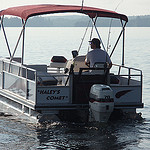
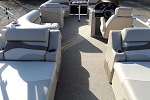
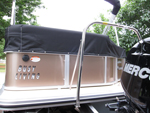

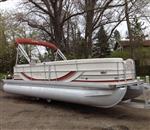
 I also found out that whomever wired it the first time was an inattentive of how they wired it, with fade and balance, I assumed that the front speakers would be the front and the rear speakers would be he rear, same thing with left and right.. but no. The front right and rear left are on the 'Front Channels' (left is left, right is right) and the front right and rear center are on the 'Rear Channels' (Right is right, center is left)